Legacy lines face January cut-off


Why hidden phone lines could stop critical systems working
Openreach has warned UK public sector bodies and emergency services that services still running on ISDN and PSTN Multiline could be lost when the old copper phone network is retired on 31 Jan 2027.
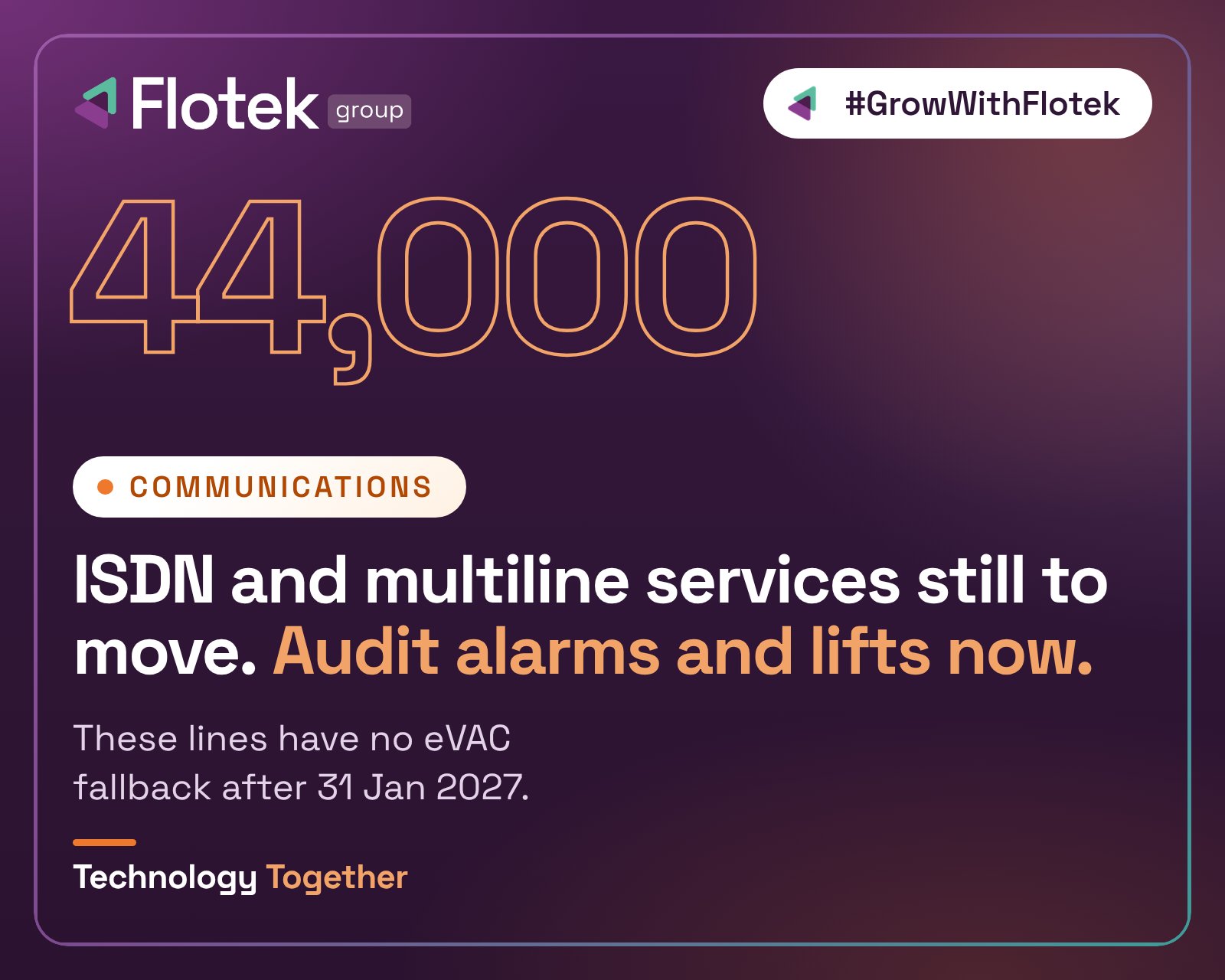
Around 44,000 of these services are still waiting to move. Many sit behind the systems people only notice when they fail: lift alarms, fire alarms, emergency call points and critical switchboards.
With roughly two months to go, the message is simple. Find these lines now, because they can’t wait for a fallback.
What Openreach has said
Openreach and BT are retiring the PSTN, the analogue network that has carried UK phone calls for decades. Fewer than a million lines are still to be migrated, and around 44,000 of those are ISDN and PSTN Multiline services.
According to Openreach, the remaining lines support hospitals, emergency services, councils, prisons, schools, universities and large corporate and industrial sites.
Most remaining phone lines won’t simply be cut off on 31 Jan 2027. Organisations that haven’t moved will eventually be placed on a temporary service called Emergency Voice Access (eVAC). Openreach describes eVAC as a last resort: it costs more and lacks some features.
Why ISDN and multiline services are different
Neither ISDN nor PSTN Multiline is compatible with eVAC. That means there’s no temporary safety net for these services. If they haven’t moved before the deadline, they could stop working.
James Lilley of Openreach warns that time is running out, and that old lines in switchboards, plant rooms or cupboards are easy to overlook. Alarms, emergency call points, monitoring systems and critical switchboards could all be seriously affected.
Where legacy lines tend to hide
Openreach lists the places these connections can sit unnoticed:
- Lift and fire alarms
- Emergency switchboards
- Care home call systems
- Alarm monitoring centres
- Utility and flood monitoring
Openreach warns that unless these systems are identified, tested and migrated before 31 Jan 2027, they could stop working, leaving vulnerable people without access to support.
What to do now
1. Audit your estate
Don’t rely on the phone bill alone. Walk your sites and check switchboards, plant rooms and cupboards for old lines, then match each one to the system it serves.
2. Get the right people in one room
Openreach advises bringing property, IT and facilities teams together. The person who manages the lift contract often isn’t the person who manages the phone lines, and that gap is where lines get missed.
3. Talk to your providers and equipment suppliers
Speak to your communications provider and the suppliers of your alarms, lifts and monitoring kit. Confirm what each device needs to work over a digital line and agree a date to test and switch it.
4. Move voice services to a modern platform
If ISDN still carries your main phone system, now is the time to move to hosted VoIP telephony. Openreach says the final price rise on 1 Oct 2026 doubled legacy line rental compared with 2025, with further rises due from February 2027, so staying put also costs more.
It can be done in time
The ISPreview report points to one fire and rescue service that started preparing six years ago and identified more than 5,000 PSTN and ISDN lines. The work was described as complicated, but the service is now confident every legacy line will move by the deadline. The lesson for everyone else is to start the audit today, not in January.
For councils and other public sector buyers, continuity and compliance sit at the heart of this. Our technology support for local councils covers exactly this kind of migration, planned around the services residents rely on.
Flotek help organisations across the UK find their remaining analogue and ISDN lines, plan each move and switch them to digital without disruption. If you’re not sure what’s still on copper, Speak to Flotek.
Further reading

Schedule a Free IT Audit & Cost Breakdown


Want it fixed and kept that way? From just £14 a month, we verify your domain and monitor it 24/7, so your email lands and nobody else can send as you.