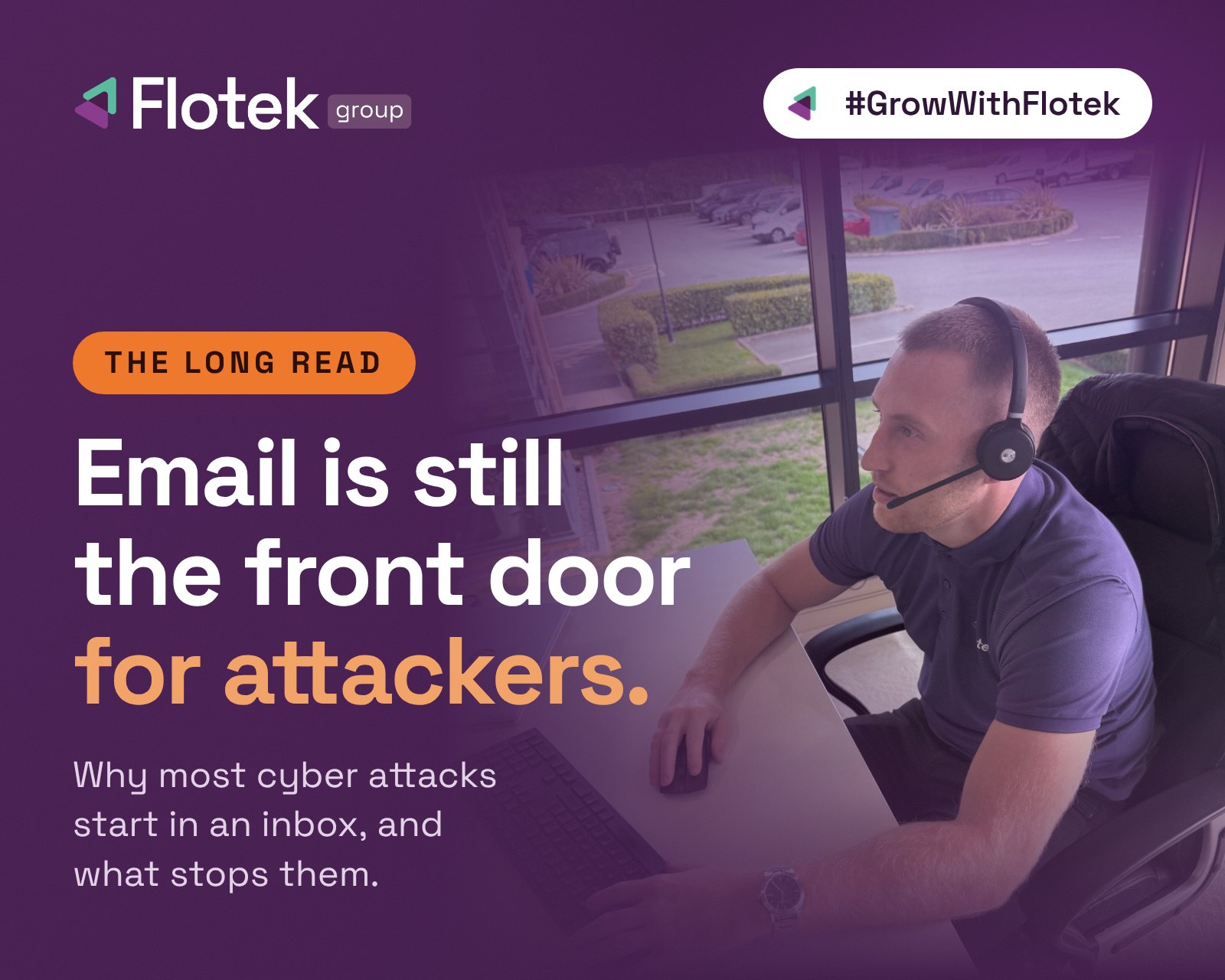
Email is still the front door for attackers


Most attacks on UK businesses still start with a message
For all the talk of Ai-powered hacking and sophisticated cyber gangs, the way most attackers get into a business hasn't changed much. They send an email and wait for someone to click.
The UK government's latest Cyber Security Breaches Survey, published in April 2026, found that 43% of UK businesses identified a cyber breach or attack in the previous 12 months. Phishing was the most common by a distance: it reached 38% of all businesses. Among the businesses that did have a breach or attack, around seven in ten said phishing was the most disruptive one they faced.
Phishing is when a criminal sends a message pretending to be someone you trust, such as a supplier, a bank, Microsoft or a colleague, to get you to click a link, open an attachment, hand over a password or make a payment.
Why email works so well for attackers
Email is the one door every business has to leave open. Your team needs to receive messages from people they've never met, open attachments and click links as part of a normal day. Attackers rely on that.
It's also cheap. One convincing message can be sent to thousands of inboxes, and the attacker only needs one person to fall for it. And because the email often comes from a real but compromised account, or a look-alike address that's one letter out, it can be very hard to spot in a busy inbox.
It's usually about your login, not your laptop
Many people picture a virus when they think of a cyber attack. More often, the target is a username and password. Security firm Sophos looked at 661 incidents its teams responded to between November 2024 and October 2025, and found that identity-based techniques, including phishing, stolen passwords and password guessing, were the root cause in 67% of cases.
Once an attacker has a working login for your Microsoft 365 account, they can read your email, send messages that come from you, and quietly set up rules to hide what they're doing. That's how a lot of invoice fraud happens: the attacker watches a real conversation about a payment, then sends a perfectly timed email with new bank details.
The basics are slipping
The same government survey found that only 47% of businesses use any form of two-factor authentication, and only 19% had given staff any cyber security training in the last 12 months. Two-factor authentication, sometimes called multi-factor authentication or MFA, means that a password on its own isn't enough to log in: you also need a code or an approval on your phone. It's one of the simplest ways to stop a stolen password being used.
Five ways to close the front door
1. Turn on multi-factor authentication everywhere
Start with email and Microsoft 365, then any system that holds money or customer data. If a password is phished, MFA is often what stops the attacker getting in.
2. Make sure your domain can't be faked
SPF, DKIM and DMARC are three settings on your email domain that tell other mail systems which senders are allowed to use your name. Without them, it's much easier for a criminal to send email that looks like it came from your business. Microsoft has also started rejecting email from domains that don't have DMARC set up, so it matters for getting your own email delivered too. Our guide to Microsoft's DMARC change explains what's happening, and Flo Verified Mail can set it up and watch it for you.
3. Slow down anything to do with money
Agree a simple rule: any request to change bank details or make an urgent payment gets checked by phone, using a number you already have, not one in the email.
4. Train people little and often
Short, regular reminders and practice phishing emails work better than a once-a-year session. The aim isn't to catch people out. It's to make "wait, is this right?" a habit.
5. Make it easy to report a mistake
People click things. What matters is how quickly they tell someone. If your team knows who to call and won't be blamed for asking, you can change a password and block an attacker before they do real damage.
The bottom line
Email isn't going anywhere, so it will stay the easiest way in for attackers. The good news is that the fixes are well understood, affordable and mostly about habits and settings rather than expensive new tools. If you'd like a hand checking how well protected your email is, get in touch with our team.
Sources: Tech Insider, Cyber Security Breaches Survey 2026 figures; SC Media UK, Cyber Security Breaches Survey analysis; Help Net Security, Sophos Active Adversary Report 2026, 27 Feb 2026.
Further reading

Schedule a Free IT Audit & Cost Breakdown


Want it fixed and kept that way? From just £14 a month, we verify your domain and monitor it 24/7, so your email lands and nobody else can send as you.