

The Future of Cyber Security: Threats & Trends Businesses Must Know



.avif)

The Future of Cybersecurity: Key Threats & Trends Businesses Must Know (2026)
Businesses are more digitally dependent than ever, relying on technology to manage practically every area of business, from customer service to procurement. This, combined with more companies adopting remote and hybrid working practices, leaves organisations more at risk of cyber threats than ever before.
It’s critical that businesses have a clear understanding of the future of cybersecurity threats and prevention methods to protect against phishing attacks, AI cyber attacks and more. We explore some of the key cybersecurity trends for 2026, demonstrating why modern cybersecurity isn’t just an IT problem – it's a whole-business problem.
Why Cyber Threats Are Evolving in 2026
Cyber threats are evolving at a rapid rate, taking advantage of the development of freely available AI to target businesses with phishing and ransomware threats in 2026. Future cyber threats will only continue to grow more efficient and convincing, with sophisticated attacks that target businesses indiscriminately.
Business cyber protection is no longer something that only applies to big businesses. SMEs are firmly in the firing line for cybercriminals, where a lack of cyber resilience and knowledge can leave them wide open to threats.
As cyber threats become more convincing thanks to the use of AI, the risk of human error is increasing, with huge businesses and small companies equally falling for threats that would have been unconvincing a few short years ago.
Finally, implementation of cloud solutions is leaving more businesses vulnerable to external interference. Without a cybersecurity strategy, SMEs are at risk in multiple ways without the proper multi-faceted business cyber protection in place.
Top Cybersecurity Threats Businesses Must Watch
AI-Powered Cyber Attacks
AI has rapidly changed the landscape of cyber threats. While AI in cybersecurity can be beneficial, providing monitoring solutions and automations, there is a darker side to this technology.
Scammers are able to harness AI to create extremely convincing deepfake videos and phishing emails, utilising your likeness, voice or writing style to mimic you to a near-perfect degree. AI also allows malware deployment to be automated, increasing the frequency of attacks. Ultimately, AI lowers the barrier for cybercriminals, making it much easier to both execute and succeed in cyber attacks.
Ransomware Becoming More Sophisticated
Ransomware has been a cautionary tale for businesses for decades, holding businesses of all sizes to ransom by locking away or encrypting essential data. These attacks are one of the biggest cybersecurity risks for SMEs, who are less likely to have the processes or knowledge in place for prevention.
Modern ransomware attacks are less scattergun than previous iterations, targeting supply chains and using double-extortion tactics where sensitive company data is stolen ahead of encryption. This technique greatly increases the incentive to pay, as simply restoring from a backup will not stop criminals from selling or leaking your data.
Advanced Phishing & Social Engineering
Modern phishing and social engineering scams are much more sophisticated, harder to spot and personalised to put pressure on you specifically. Personalised phishing attacks target you individually, using emotionally manipulative or urgent scenarios in an attempt to steal credentials or access funds.
Some of the common techniques for scammers include:
- Compromising the accounts of a trusted person and requesting money or sensitive data through the use of AI-generated emails.
- Creating deepfake AI voice cloning of a CEO or supplier to pressurise you into taking action.
- Providing fake error messages or CAPTCHA prompts that bypass email security by running scripts or pasting code into a browser.
Many of these scams rely on email that looks like it comes from someone you trust. Check your own domain for free to see whether it passes the checks Gmail and Outlook now require.
Cloud Security Risks
The majority of modern businesses utilise cloud services for anything from software access to data management. While cloud systems are extremely efficient, they are also a risk if you don’t keep up with cloud security trends. Failure to implement proper access controls can easily allow access from an unauthorised third-party.
Beyond this, misconfiguration of your cloud resources can leave big gaps that allow access to passwords, data and other vital information. Likewise, third-party applications connected to the cloud can be sources of vulnerability, putting your business at risk if they are obsolete or not updated consistently, leaving an open window for malicious activity.
Human Error
One of the biggest risks to businesses across the globe, and the most significant threat to your cybersecurity, continues to be one factor: human error. The people in your business are often the open door that gives cybercriminals access to your organisation, accounting for up to 95% of all cyberbreaches.
The reason techniques like phishing and vishing work so well is they aren’t targeting secure systems or heavily protected data directly. Instead, they aim for a much softer target. The people you employ are able to be manipulated and directed to take actions that threaten your business with a much higher success rate than any other type of cyberattack.
Key Cyber Security Trends for 2026
Zero Trust Security Becoming Standard
Zero Trust architecture (ZTA) assumes that there is no implicit trust for access to user accounts or assets. Essentially, it means that no one is ever trusted, and verification is always a necessary step to effectively protect resources. This method requires continual authorisation via multi-factor authentication regardless of whether you are in the office or at home. This helps to significantly reduce vulnerabilities and limit the radius of cyber attacks.
AI Being Used for Cyber Defence
AI is a powerful tool for threat detection, providing an automated and immediate response to incidents faster than any human response. AI is capable of uncovering anomalies and misconfigurations in rapid time. When used by a skilled professional, AI in cybersecurity can be an effective supplement to human experience and intuition. AI may be a risk to businesses, but it can also be a benefit to your cybersecurity if applied correctly.
Greater Focus on Cyber Resilience
Strategic cybersecurity for businesses should focus on proactivity as well as fast reactivity. Cyber resilience protects your business against the after-effects of a cyberattack. This includes backup strategies, disaster recovery processes and business continuity planning. By looking ahead, you can recover quickly from attacks and minimise their impact on your business.
Managed Security Services Growing
Cybersecurity is essential for all modern businesses, but many companies – especially SMEs – don't have the resources and knowledge in-house to keep up with the ever-changing landscape of cyber threats. Managed cybersecurity services, as part of fully managed IT support packages, are growing in popularity as an outsourced solution for 24/7 protection, giving access to expert support and guidance to keep your business safe.
What These Trends Mean for Businesses
Seemingly every day, new stories of businesses becoming victims of cyberattacks pop up. Protecting your business is essential to prevent risk and to comply with your legal and insurance requirements. Failing to do so could be a serious threat to your business, affecting both your revenue and reputation.
As cyber threats rapidly evolve, cybersecurity should no longer be the concern of your IT department or service alone; it’s a board-level concern. It’s crucial that the entirety of your business understands the seriousness of cybersecurity threats. In addition to education, now is the time to invest proactively in security to safeguard your business.
How Businesses Can Prepare for the Future of Cybersecurity
Taking practical steps towards improved cybersecurity is the best way to prepare for future cyber threats today. Some of the measures you can take include:
- Implement MFA across your whole company, including in-office and remote/hybrid employees.
- Invest in staff training to increase their awareness of threats.
- Review your existing access permissions and third-party applications.
- Patch your systems regularly, in line with the 14-day rule.
- Ensure your cloud environments are secure.
- Prepare incident response plans to handle cyberattacks.
- Work with a cybersecurity support provider to create a proactive strategy.
At Flotek, we work as a cybersecurity partner for businesses across the UK. Our expertise across in-office and remote IT support services enables us to protect your business effectively. We utilise a robust process to safeguard your business, including 24/7 monitoring with CyberGuard and providing Cyber Essentials certification. Contact our team today to learn more.





.jpg)







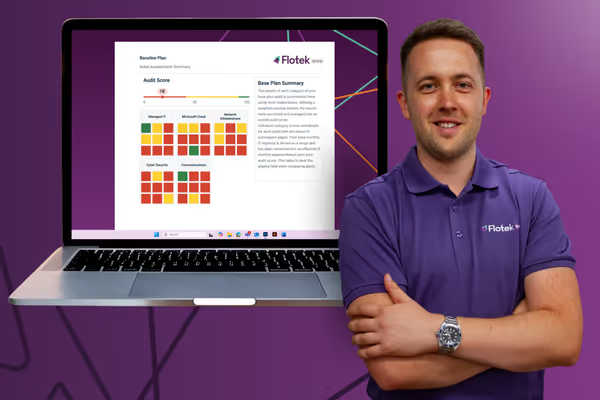
Schedule a Free IT Audit & Cost Breakdown


Want it fixed and kept that way? From just £14 a month, we verify your domain and monitor it 24/7, so your email lands and nobody else can send as you.









.avif)
.avif)
%20(1).avif)